


Management Education as Strategy, Not Just Qualification
An MBA or PGDM is often perceived as a gateway to better salaries, corporate roles, or managerial titles. While these outcomes are real, they represent only the visible surface of what management education truly offers. At its core, an MBA/PGDM is a transformation of perspective—a shift from task-based thinking to decision-based thinking, from execution to strategy, and from individual contribution to organizational impact. Within this section of PappalKushal.com, management education is not positioned as a default next step after graduation, but as a strategic choice that must be evaluated with depth, clarity, and long-term vision.
In today’s competitive landscape, the value of an MBA is no longer defined by the degree alone, but by the context in which it is pursued—the institution, specialization, peer environment, industry exposure, and the individual’s ability to extract value from the experience. Many aspirants enter management programs with unclear expectations, often driven by trends or external influence, only to realize later that the outcome depends significantly on the decisions made before and during the program. This platform addresses that gap by helping you understand not just what an MBA is, but when it is right, where it holds value, and how it should be approached to create meaningful career leverage.
The journey begins with understanding the fundamental distinction between MBA and PGDM programs, not merely at a technical level, but in terms of flexibility, curriculum design, and industry integration. While MBA programs are typically university-affiliated and structured within academic frameworks, PGDM programs—especially those offered by reputed autonomous institutions—often provide greater adaptability, industry-aligned curricula, and evolving course structures. This distinction becomes critical when evaluating long-term relevance, especially in rapidly changing business environments where static knowledge quickly loses value.
Equally important is the decision of specialization, which should never be treated as a casual or last-minute choice. Domains such as finance, marketing, human resources, operations, business analytics, and strategy each demand different skill sets and offer distinct career trajectories. Selecting a specialization requires a clear understanding of your strengths, interests, and tolerance for analytical, creative, or operational roles. This section guides you to evaluate these dimensions thoughtfully, ensuring that your choice is not based on perceived popularity, but on genuine alignment with your capabilities and long-term vision.
For many aspirants, one of the most critical and often misunderstood aspects of management education is the entrance preparation phase. Exams such as CAT, XAT, GMAT, and others are not merely tests of knowledge, but assessments of aptitude, speed, decision-making, and consistency under pressure. Preparation without structure often leads to inefficiency and burnout. To address this, you are guided to begin with clarity through /education-career/government-exams/preparation-guides/how-to-start/, where confusion is replaced with direction, followed by structured planning through /education-career/government-exams/preparation-guides/study-plan/, enabling you to convert preparation into a disciplined system. Resource selection is further optimized through /education-career/government-exams/preparation-guides/booklist/, ensuring that your focus remains on quality rather than quantity, while /education-career/government-exams/preparation-guides/note-making/ helps you build retention systems that support long-term performance. Sustaining this journey without exhaustion becomes equally important, which is why /education-career/government-exams/preparation-guides/burnout-management/ plays a critical role in maintaining consistency over extended preparation periods.
As you progress from preparation into the program itself, the nature of learning changes significantly. Classroom knowledge must be actively connected with real-world application through internships, live projects, case studies, and peer collaboration. The value of an MBA is deeply influenced by how effectively you engage with these opportunities. Passive participation leads to average outcomes, while active involvement, networking, and skill-building create differentiation. This section emphasizes the importance of viewing the MBA not as a two-year academic phase, but as a high-intensity professional development period where every interaction, project, and decision contributes to your future positioning.
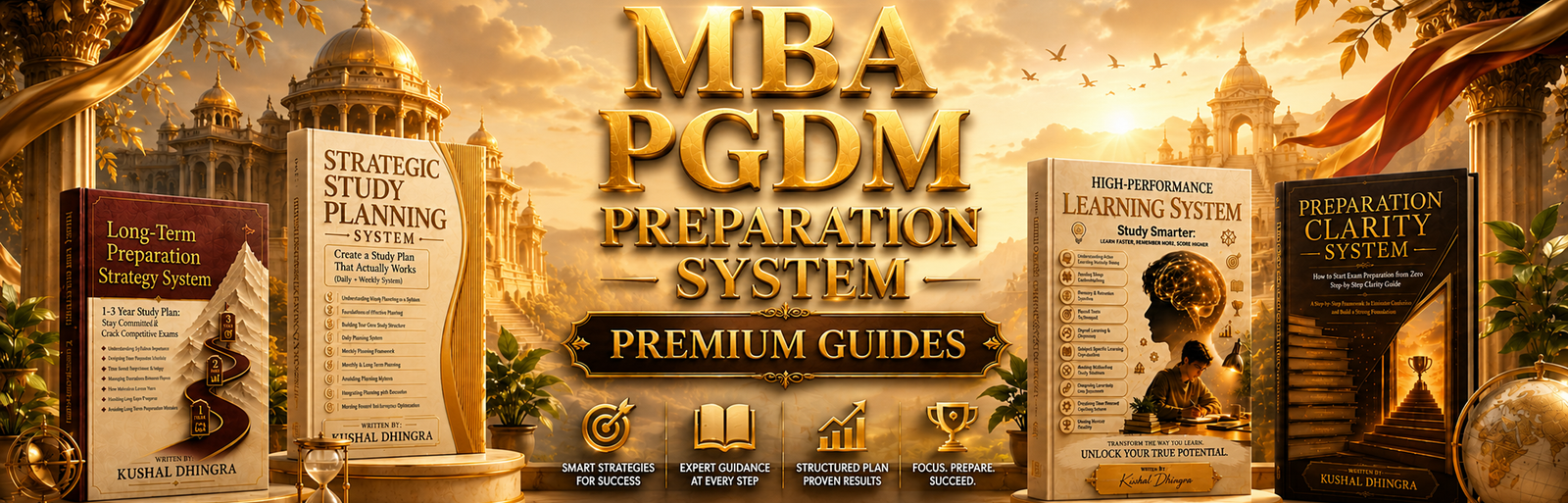
At this stage, where effort must translate into structured execution, the platform introduces premium PDF Guides (E-books) designed specifically for serious aspirants and management students. These guides are built to provide clarity in preparation, efficiency in execution, and consistency in performance. They go beyond generic advice, offering structured systems for time management, study optimization, concept clarity, and strategic preparation—ensuring that you do not rely on trial-and-error methods during one of the most critical phases of your career journey. For those who seek to maximize their return on effort and investment, these guides serve as practical tools that bridge the gap between knowledge and results.
However, the impact of an MBA extends far beyond academic and technical learning. It plays a crucial role in shaping your professional identity, communication style, leadership ability, and decision-making confidence. This is why you are encouraged to strengthen these dimensions through /education-career/personality-development/, where essential skills such as communication, leadership, and interview readiness are developed alongside your academic journey. At the same time, staying aligned with real-world expectations is critical, and /education-career/job-market-awareness/ provides insights into hiring trends, salary benchmarks, and industry demand, ensuring that your efforts remain relevant and strategically aligned.
For individuals who aspire to move beyond corporate roles and explore independent pathways, the platform also connects management education with entrepreneurial opportunities. Through /education-career/msme-business-ideas/ and /education-career/business-setup-guides/, you can explore how business knowledge can be translated into practical ventures, allowing you to apply your learning in dynamic, self-driven environments. This reinforces a key principle: an MBA is not limited to employment—it is a foundation for multiple career directions, including leadership, consulting, and entrepreneurship.
The decision to pursue an MBA or PGDM should therefore never be impulsive. It requires careful evaluation of timing, financial investment, career goals, and personal readiness. When approached with clarity and supported by structured preparation and execution, it can become one of the most powerful accelerators of professional growth. When pursued without direction, it risks becoming an expensive and underutilized qualification.
This section is designed to ensure that you remain on the right side of that equation. It provides not just information, but perspective; not just options, but direction; and not just guidance, but a system that supports you from decision-making to execution.
Choose your path with awareness, prepare with discipline, engage with intention, and when you are ready to move beyond uncertainty, step into the structured frameworks designed to help you extract the full value of your management journey.