


Legal Reasoning, Judicial Authority, and the Discipline of Structured Thinking
The judiciary represents one of the most intellectually demanding and ethically grounded career pathways, where the responsibility extends beyond professional success into the realm of justice, interpretation of law, and protection of constitutional values. Unlike many other careers that focus on execution or administration, the field of law and judiciary is built upon reasoning, analysis, and the ability to interpret complex systems with clarity and balance. Within PappalKushal.com, this section is designed to help you approach judiciary and CLAT preparation not as a conventional academic pursuit, but as a disciplined intellectual journey that requires precision, depth, and a structured approach to thinking.
At its core, the legal field operates on principles rather than memorization. It demands the ability to analyze situations, interpret statutes, evaluate arguments, and construct logical conclusions based on evidence and reasoning. Whether you are preparing for CLAT to enter premier law institutions or aiming for judiciary examinations to become a judge, the foundation remains the same—clarity of concepts, strength in reasoning, and the ability to apply knowledge in dynamic scenarios. This makes legal preparation fundamentally different from other competitive examinations, as it emphasizes understanding over repetition and logic over memorization.
The journey within this section begins with clarity of direction, as aspirants must first identify their pathway within the legal domain. For those at the entry stage, CLAT serves as the gateway to top law universities, where foundational legal education is developed. For those pursuing a career in judicial services, the focus shifts toward state judiciary examinations, which require deeper knowledge of laws, procedural codes, and practical application. Understanding this distinction is essential, as preparation strategies differ significantly based on the chosen path, and clarity at this stage ensures focused and efficient effort.
Once the direction is established, the focus shifts toward building a preparation system that emphasizes both conceptual clarity and analytical ability. This begins with /education-career/government-exams/preparation-guides/how-to-start/, where aspirants are guided to establish a clear foundation by understanding the syllabus, exam structure, and preparation strategy. This clarity is then translated into execution through /education-career/government-exams/preparation-guides/study-plan/, which helps in organizing preparation into structured phases, ensuring that each subject is covered systematically while allowing sufficient time for practice and revision.
Resource selection plays a crucial role in legal preparation, as the availability of multiple materials often leads to confusion and fragmented understanding. Through /education-career/government-exams/preparation-guides/booklist/, aspirants are guided to focus on essential and high-quality resources that build conceptual clarity and support analytical thinking. As legal reasoning requires not only understanding but also retention and application, /education-career/government-exams/preparation-guides/note-making/ provides structured techniques to organize legal concepts, case laws, and key principles in a way that supports both recall and interpretation. At the same time, maintaining consistency over long preparation cycles requires mental discipline, making /education-career/government-exams/preparation-guides/burnout-management/ an essential component in sustaining focus and avoiding fatigue.
As preparation advances, the emphasis must shift toward performance-oriented learning, where practice tests, case analysis, and reasoning exercises become central to improving outcomes. Legal examinations often include comprehension-based questions, logical reasoning, and scenario-based analysis, requiring aspirants to apply their knowledge in structured and time-bound environments. This stage demands continuous practice, self-evaluation, and refinement of analytical skills, ensuring that preparation translates into performance.
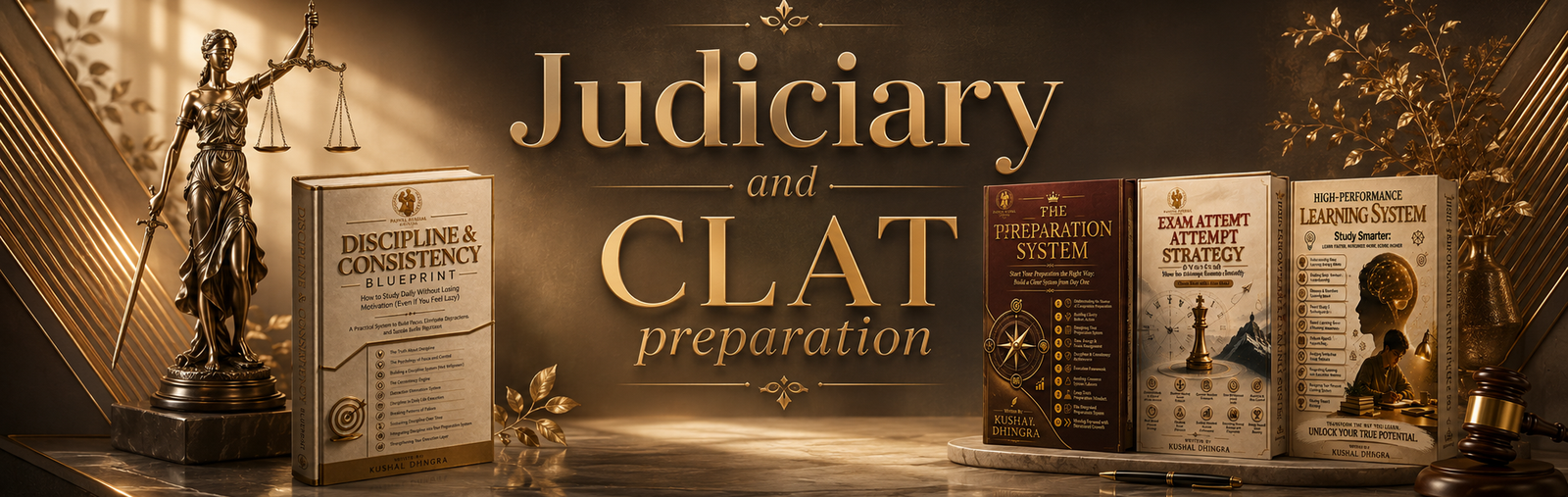
At this critical stage, where preparation must evolve into structured execution, the platform introduces premium PDF Guides (E-books) designed specifically for aspirants preparing for judiciary and CLAT examinations. These guides provide structured frameworks for managing preparation, strengthening legal reasoning, organizing revision cycles, and improving analytical performance. They are designed to eliminate inefficiencies, reduce confusion, and provide a clear pathway from preparation to performance. For aspirants who understand that legal success depends on clarity and precision, these guides serve as a valuable tool in bridging the gap between knowledge and application.
Beyond the examination, it is equally important to understand the professional opportunities and responsibilities associated with the legal field. Careers in judiciary, litigation, corporate law, and legal advisory require not only knowledge, but also ethical integrity, communication skills, and the ability to think independently. To align preparation with these expectations, aspirants are encouraged to explore /education-career/job-market-awareness/, where insights into career progression, roles, and opportunities within the legal domain provide a realistic perspective. At the same time, developing communication, confidence, and argumentation skills through /education-career/personality-development/ ensures that aspirants are prepared not only to clear the examination, but also to perform effectively in professional environments.
For those who wish to expand their career beyond traditional legal roles, the platform also connects legal preparation with broader opportunities such as consultancy, advisory services, and independent practice through /education-career/msme-business-ideas/ and /education-career/business-setup-guides/, ensuring that the skills developed during preparation remain valuable across multiple domains.
The journey toward judiciary and legal careers is therefore not defined by memorization—it is defined by clarity, reasoning, and the ability to interpret complex systems with precision. It requires a structured approach to preparation, a deep understanding of legal principles, and the ability to apply knowledge effectively.
This section is designed to ensure that your preparation remains structured, meaningful, and aligned with your goals. It provides not just information, but a refined framework for thinking, preparing, and executing at a level that reflects the true nature of law and justice.
Develop clarity of reasoning, strengthen your analytical thinking, and prepare with purpose. Build your path with structured systems, refine your understanding with discipline, and when you are ready to move beyond uncertainty, step into the frameworks designed to support your journey in the field of law and judiciary.