

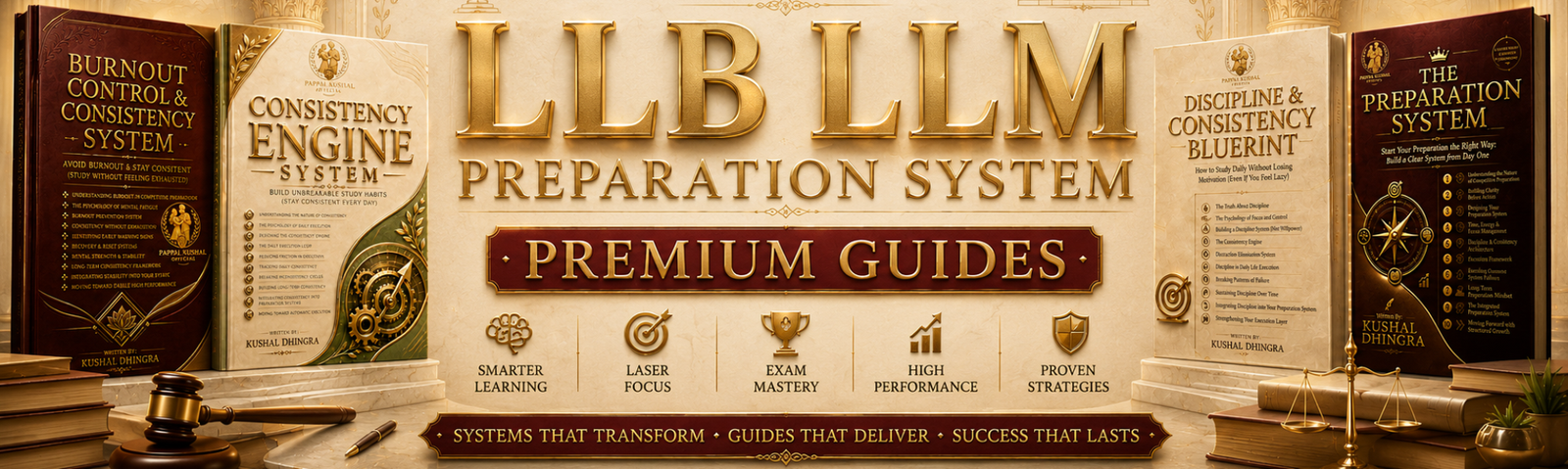
LLB LLM Preparation System
The field of law has always operated differently from most academic and professional disciplines. It is not merely a system of memorizing statutes, learning legal terminology, or understanding courtroom procedures. Law is fundamentally a discipline of interpretation, analytical reasoning, structured argumentation, intellectual precision, and the ability to apply principles within complex real-world situations where clarity, logic, and judgment carry enormous significance. This is why the journey through LLB and LLM preparation gradually becomes far more demanding than many aspirants initially expect.
At the beginning, legal education often appears manageable. Students believe that reading regularly, understanding concepts, attending lectures, and preparing notes consistently will naturally lead toward strong academic and professional performance. In the early stages, this assumption may even appear correct. Subjects feel understandable, progress seems visible, and preparation appears controllable. However, as the depth of legal education increases, the true nature of law gradually begins revealing itself. Constitutional interpretation demands conceptual precision. Criminal law requires analytical thinking. Jurisprudence develops abstract reasoning. Contract and corporate law demand structured interpretation. Legal research introduces intellectual complexity. Case laws require deep contextual understanding rather than superficial reading. Over time, preparation transforms from ordinary studying into an intellectually demanding process where comprehension, retention, analytical application, and structured argumentation must continuously function together.
This transition becomes the stage where many aspirants begin facing invisible structural difficulties inside preparation itself. They continue studying seriously, yet clarity becomes unstable. Notes become larger while retention weakens. Reading hours increase, yet conceptual understanding does not deepen proportionally. Planning systems collapse under syllabus pressure. Revision becomes inefficient because legal concepts remain interconnected rather than isolated. Many students begin restarting preparation repeatedly, changing methods, collecting excessive resources, or consuming scattered legal content online without solving the actual structural inefficiencies responsible for unstable performance.
The problem, in most cases, is not intelligence or seriousness. It is the absence of a structured preparation architecture capable of supporting analytical and long-duration legal learning environments.
Law preparation cannot survive through scattered effort for long. Legal education demands continuity of reasoning, conceptual integration, structured revision systems, disciplined execution, and the ability to sustain intellectual consistency over extended periods without collapsing into overload, confusion, or fragmented understanding. Without a connected framework, even highly disciplined aspirants gradually experience accumulated inefficiencies that weaken preparation quality over time. Weak planning systems create inconsistent subject coverage. Poor revision structures reduce legal recall and interpretation accuracy. Unorganized execution creates mental overload. Excessive resources increase confusion instead of clarity. Long preparation cycles slowly produce intellectual exhaustion because preparation itself lacks operational structure.
This is precisely why legal preparation eventually becomes more strategic than emotional.
Most aspirants already possess enough information. Modern legal education environments already provide lectures, PDFs, coaching materials, notes, online resources, case summaries, and preparation content in unlimited quantities. The real challenge is no longer access to information. The real challenge becomes organization — converting legal preparation into a structured system where planning, learning, revision, analytical interpretation, examination execution, and long-term continuity support one another rather than functioning separately without alignment.
The LLB/LLM Structured Preparation Bundle has been designed specifically for this stage where preparation must evolve beyond scattered study patterns and become system-driven execution.
Rather than functioning as generic informational books, these frameworks operate as interconnected preparation systems where each component addresses a specific breakdown point commonly experienced during legal education and law entrance preparation journeys. Some systems strengthen planning and execution quality. Some improve conceptual understanding and analytical learning efficiency. Some optimize revision and structured retention. Some improve examination handling and legal reasoning under pressure. Some create long-term preparation continuity capable of sustaining intellectual consistency across demanding academic and professional legal environments.
Together, these systems create a complete legal preparation architecture where effort becomes more organized, learning becomes more structured, execution becomes measurable, and preparation gradually transforms from scattered academic activity into professional-level progression.
This distinction matters because legal preparation rarely collapses suddenly. It declines gradually through repeated inefficiencies that remain unresolved for too long. Weak revision systems today become unstable recall later. Poor planning systems today become overwhelming syllabus pressure later. Inconsistent execution today becomes delayed academic and professional progression later. Over time, these hidden inefficiencies accumulate until preparation begins feeling mentally exhausting despite genuine effort and serious intent.
The individuals who successfully navigate demanding legal education environments are rarely operating through motivation alone. They are operating through structured systems capable of sustaining analytical clarity, intellectual consistency, revision stability, and disciplined execution even during phases where emotional motivation naturally declines.
This is why preparation architecture matters more than temporary intensity.
For those who have already reached the stage where effort exists but consistency, clarity, retention, and structured execution remain unstable, the next step is not searching for more scattered information or additional random strategies. The next step is adopting a preparation framework capable of organizing legal preparation into measurable, sustainable, and strategically aligned progression.
The complete LLB/LLM Structured Execution Framework can be explored here →
Continuing legal preparation without structure rarely maintains the same position for long. Gradually, it increases inefficiency, weakens analytical stability, destabilizes revision systems, reduces execution quality, and extends the preparation journey far beyond what is necessary.
Law is not mastered through scattered effort. It is mastered through disciplined systems capable of sustaining intellectual clarity, structured reasoning, and analytical consistency across long academic and professional journeys. And sustainable legal performance is never accidental. It is built structurally.
The complete LLB/LLM Structured Execution Framework can be explored here →
