

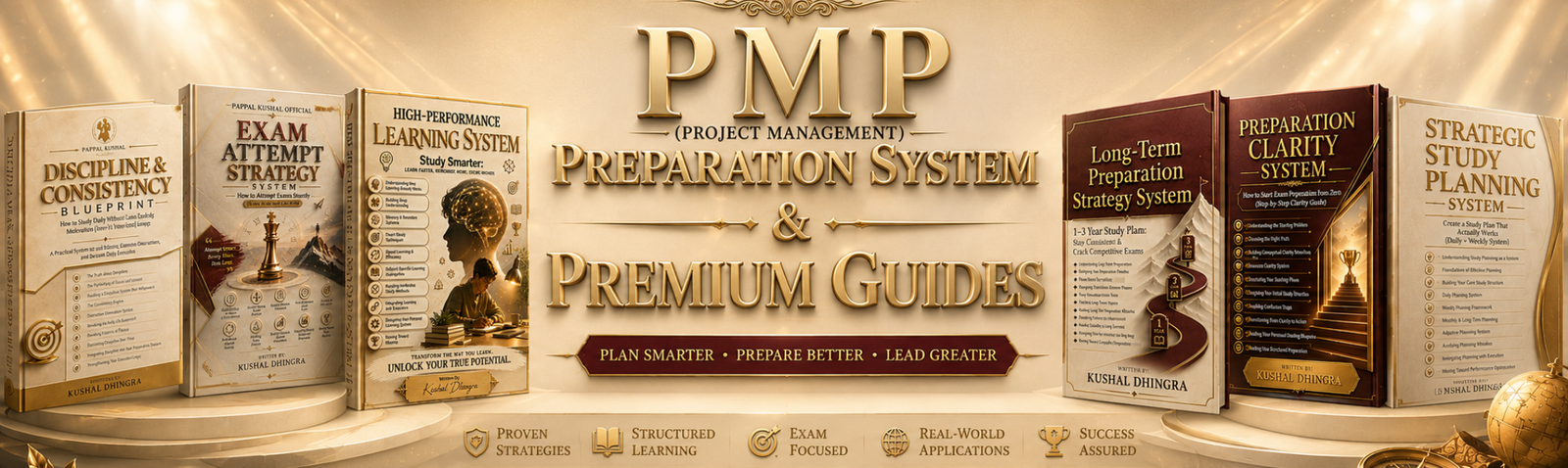

PMP Project Management Preparation System
Project management is often misunderstood as a technical profession focused only on timelines, task allocation, reporting systems, or operational supervision. In reality, effective project management represents something far more complex and valuable. It is the discipline of converting vision into execution, uncertainty into structured progress, and fragmented activity into measurable outcomes. Whether in technology, construction, healthcare, finance, consulting, manufacturing, or enterprise operations, organizations do not succeed because ideas exist. They succeed because execution is managed with precision, accountability, strategic coordination, and operational clarity.
This is precisely why certifications such as PMP (Project Management Professional) have gained global professional significance. They are not merely academic credentials or theoretical qualifications. They represent structured execution frameworks designed to help professionals manage complexity, coordinate teams, optimize workflows, control risks, align stakeholders, and deliver outcomes efficiently under real-world pressure. However, despite the professional value associated with project management certifications, many aspirants gradually discover that preparing for PMP and execution-focused leadership roles becomes more demanding than they initially expected.
At the beginning, the preparation journey often appears straightforward. Professionals assume that disciplined reading, understanding project management concepts, following PMBOK frameworks, attending training sessions, and solving practice questions consistently will naturally produce confidence and examination readiness. Initially, progress may even feel manageable. Concepts seem understandable, preparation appears organized, and momentum feels stable.
However, as the preparation deepens, a different reality gradually begins to emerge. Project management is fundamentally a systems discipline. It requires interconnected thinking across scope management, stakeholder alignment, execution planning, resource allocation, cost control, scheduling frameworks, communication structures, risk mitigation, quality assurance, and adaptive decision-making under changing conditions. Over time, preparation evolves beyond simple studying into a layered intellectual and operational process where analytical understanding, structured execution, strategic thinking, and long-term consistency must continuously function together.
This transition becomes the stage where many aspirants begin experiencing hidden structural inefficiencies inside preparation itself. Study hours increase, yet execution clarity weakens. Planning systems become more complicated but less sustainable. Resources expand while retention becomes unstable. Practice continues, yet examination confidence remains inconsistent. Professionals balancing careers with preparation struggle to maintain execution stability across weeks and months. Many begin restarting plans repeatedly, consuming scattered online content, changing preparation methods, or collecting excessive resources without solving the actual structural problem responsible for inconsistent progress.
The problem, in most cases, is not effort.
It is the absence of structured preparation architecture capable of supporting execution-heavy and long-duration professional learning environments.
Project management preparation cannot survive for long on scattered effort alone because the profession itself is based on systems thinking. Without a connected execution structure, preparation gradually becomes fragmented. Weak planning systems create overload. Poor execution cycles reduce measurable progress. Inconsistent routines weaken long-term retention. Unoptimized preparation structures increase mental fatigue. Over time, even highly disciplined professionals begin losing operational efficiency because preparation itself lacks alignment.
This is why PMP preparation eventually becomes less about consuming information and more about building systems capable of sustaining professional-level execution consistency.
Most aspirants already possess enough information. Modern professional education environments already provide books, courses, notes, lectures, frameworks, mock tests, and online preparation material in overwhelming quantities. The real challenge is no longer access to information.
The real challenge becomes organization.
How do you convert scattered preparation into a structured operational system where planning, execution, performance optimization, decision-making, consistency, and long-term professional growth reinforce one another continuously instead of operating separately without alignment?
The PMP & Project Management Structured Preparation Bundle has been designed specifically for this stage where preparation must evolve beyond ordinary studying and become system-driven execution.
Rather than functioning as disconnected informational books, these frameworks operate as interconnected professional execution systems where each component addresses a specific breakdown point repeatedly experienced during preparation and professional performance environments. Some systems strengthen execution discipline and structured action. Some optimize productivity and operational efficiency. Some improve planning quality and execution consistency. Some stabilize long-term professional preparation cycles. Some strengthen strategic decision-making under examination pressure and real-world execution conditions.
Together, these systems create a complete project management preparation architecture where effort becomes measurable, execution becomes optimized, consistency becomes sustainable, and preparation gradually transforms from scattered professional activity into structured operational progression.
This distinction matters because project management itself is not a profession built on random activity. It is built on systems, frameworks, coordination, accountability, and structured execution under pressure. Preparing for such a discipline without structure eventually creates the same inefficiencies the profession itself is designed to eliminate.
The professionals who consistently succeed inside demanding execution environments are rarely operating through motivation alone. They are operating through repeatable systems capable of sustaining clarity, productivity, execution discipline, strategic control, and long-term consistency even during periods of high pressure, uncertainty, and operational complexity.
This is why preparation architecture matters more than temporary intensity.
For those who have already reached the stage where effort exists but execution consistency, planning stability, performance optimization, and long-term structure remain unstable, the next step is not searching for more scattered content or additional random strategies. The next step is adopting a preparation framework capable of converting professional effort into measurable operational progression.
The complete PMP & Project Management Structured Execution Framework can be explored here →
Continuing professional preparation without structure rarely maintains the same position for long. Gradually, it increases inefficiency, weakens consistency, destabilizes execution quality, reduces productivity, and extends professional growth cycles far beyond what is necessary.
Project management is not mastered through scattered effort. It is mastered through systems capable of sustaining execution clarity, structured thinking, operational discipline, and measurable delivery across complex professional environments. And high-level execution is never accidental. It is built structurally.
The complete PMP & Project Management Structured Execution Framework can be explored here →