


Global Representation, Strategic Diplomacy, and the Intelligence of International Relations
The Indian Foreign Service (IFS) stands at the intersection of national interest and global engagement, representing one of the most intellectually refined and strategically sensitive roles within the civil services framework. Unlike administrative or law enforcement positions that operate primarily within domestic boundaries, the IFS extends India’s presence across the world, shaping diplomatic relations, negotiating international agreements, protecting national interests abroad, and building long-term global partnerships. Preparing for the IFS is therefore not simply about clearing an examination—it is about developing a global perspective, analytical depth, cultural awareness, and the ability to operate with precision in complex international environments. Within PappalKushal.com, this section is designed to guide you through that transformation, where preparation evolves into global competence and ambition aligns with responsibility on an international stage.
At its core, the IFS role is defined by the ability to understand and interpret global systems—political, economic, cultural, and strategic—and to represent national interests within those systems with clarity and balance. Diplomacy is not merely communication; it is structured negotiation, strategic positioning, and the careful management of relationships where every decision carries long-term implications. This requires a deep understanding of international relations, geopolitical dynamics, economic policies, global institutions, and cultural sensitivities. The preparation for IFS must therefore go beyond academic study and develop the ability to think critically about global issues, connect events across regions, and respond with informed judgment.
The journey toward IFS begins within the broader UPSC framework, but it requires a specialized orientation toward international affairs and analytical thinking. Aspirants are encouraged to first build a clear understanding of the examination structure through /education-career/government-exams/upsc/, where the Preliminary, Mains, and Interview stages are presented as an integrated evaluation system. However, moving specifically toward IFS requires an additional layer of focus—developing a strong command over subjects such as international relations, global economics, current affairs, and India’s foreign policy. This clarity ensures that preparation is not only aligned with the examination, but also with the nature of the role itself.
A critical aspect of IFS preparation is the integration of static knowledge with dynamic global developments. Subjects such as history, polity, and economics must be studied in connection with contemporary international events, enabling aspirants to understand not just what has happened, but what is evolving and why. This level of integration requires a structured preparation system, beginning with /education-career/government-exams/preparation-guides/how-to-start/, where aspirants establish clarity in approach, define realistic timelines, and understand the depth of the syllabus. This is followed by /education-career/government-exams/preparation-guides/study-plan/, which organizes preparation into disciplined phases, ensuring consistent progress across all subjects while maintaining focus on international relevance.
Resource management plays a crucial role in maintaining efficiency during preparation, particularly given the vast amount of information available in the domain of international relations. Through /education-career/government-exams/preparation-guides/booklist/, aspirants are guided to focus on essential and high-quality resources that provide depth and clarity, avoiding unnecessary distraction. As retention and structured revision are essential for success, /education-career/government-exams/preparation-guides/note-making/ offers techniques to organize information effectively, enabling aspirants to connect global developments with core concepts and recall them efficiently during examinations. At the same time, the long duration and intensity of preparation require sustained mental resilience, which is why /education-career/government-exams/preparation-guides/burnout-management/ becomes a vital component in maintaining consistency and focus.
As preparation advances, the emphasis must shift toward analytical expression and performance. The Mains examination requires aspirants to present well-structured, balanced, and globally aware answers that reflect both knowledge and perspective. The ability to analyze international events, evaluate policy implications, and present reasoned arguments becomes central to achieving high scores. Similarly, the Interview stage demands confidence, clarity, and the ability to engage in meaningful discussions on global issues, reflecting both intellectual depth and diplomatic temperament.
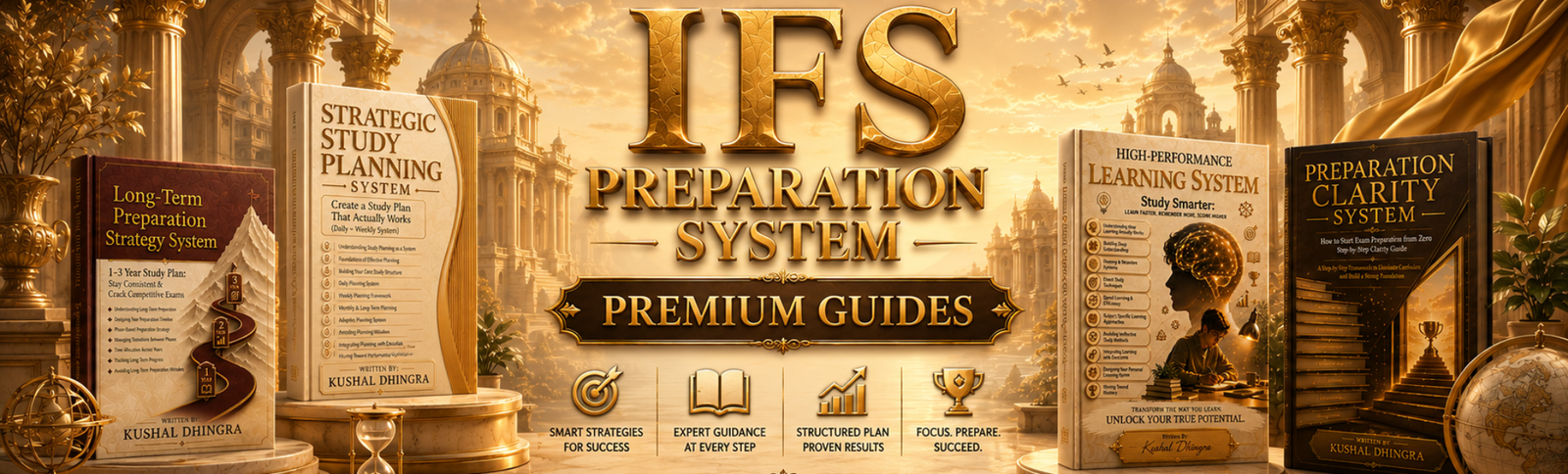
At this advanced stage, where preparation must evolve into precision and refined execution, the platform introduces premium PDF Guides (E-books) designed specifically for serious aspirants preparing for high-level competitive examinations. These guides provide structured frameworks for managing preparation, improving answer-writing skills, optimizing revision strategies, and maintaining consistency over extended study cycles. They are designed to eliminate inefficiencies, enhance conceptual clarity, and provide a clear pathway from preparation to performance. For aspirants who seek a disciplined and strategic approach, these guides serve as a valuable tool in transforming effort into measurable outcomes.
Beyond the examination, it is essential to understand the real-world responsibilities and expectations associated with the IFS role. Diplomats operate in diverse cultural and political environments, requiring adaptability, communication skills, and the ability to represent national interests with professionalism and integrity. To align preparation with these expectations, aspirants are encouraged to explore /education-career/job-market-awareness/, where insights into career progression, responsibilities, and global roles provide a realistic understanding of life within the foreign service. At the same time, developing strong communication, confidence, and interpersonal skills through /education-career/personality-development/ ensures that aspirants are prepared to engage effectively in diplomatic settings.
For those who wish to maintain a broader perspective in their career journey, the platform also connects IFS preparation with alternative global and entrepreneurial pathways through /education-career/msme-business-ideas/ and /education-career/business-setup-guides/, ensuring that the skills developed during preparation remain valuable across multiple domains.
The journey toward IFS is therefore not defined by ambition alone—it is defined by intellectual depth, global awareness, and disciplined preparation. It requires the ability to think beyond borders, understand complex systems, and operate with clarity in environments where every decision carries strategic significance. When approached with structure and supported by the right systems, it becomes a pathway to representing the nation at the highest international levels. When pursued without direction, it often leads to inefficiency and lack of focus.
This section is designed to ensure that your preparation remains structured, purposeful, and aligned with your long-term vision. It provides not just information, but a refined framework for thinking, preparing, and executing at a level that reflects the true nature of diplomacy and global engagement.
Develop a global perspective, strengthen analytical depth, and prepare with disciplined systems. Think beyond boundaries, act with clarity, and when you are ready to move beyond uncertainty, step into the frameworks designed to support your journey in international diplomacy and foreign service.