


Legal Intelligence, Structured Reasoning, and the Power to Interpret Systems
Law is often perceived as a profession of arguments, courtrooms, and litigation, but its true nature extends far beyond visible proceedings. It is the underlying framework that governs societies, regulates institutions, defines rights, resolves conflicts, and shapes the balance between authority and individual freedom. Pursuing LLB or LLM is therefore not merely an academic decision—it is an entry into a discipline that demands intellectual rigor, ethical awareness, analytical precision, and the ability to interpret complex systems with clarity. Within PappalKushal.com, this section is designed to help you approach legal education not as a default career option, but as a deeply structured and intellectually demanding pathway that requires clarity of purpose and long-term commitment.
At its foundation, legal education develops a unique way of thinking. Unlike many other disciplines that rely on memorization or formula-based problem-solving, law requires interpretation, reasoning, and the ability to construct logical arguments based on principles, precedents, and statutory frameworks. The LLB program introduces you to core legal domains such as constitutional law, criminal law, contract law, administrative law, and civil procedures, building a comprehensive understanding of how legal systems function at both theoretical and practical levels. LLM, as an advanced specialization, takes this understanding further, allowing you to focus on specific areas such as corporate law, international law, human rights, intellectual property, or taxation, thereby positioning you for specialized roles within the legal ecosystem.
The decision to pursue LLB or LLM must therefore be guided by more than surface-level awareness. It requires a clear understanding of the nature of legal work, the demands of the profession, and the diversity of career pathways available. Law is not limited to litigation; it extends into corporate advisory, compliance, policy-making, judiciary services, academia, and international legal consulting. This section helps you evaluate these possibilities in depth, ensuring that your decision is aligned not only with your interests, but also with your long-term professional vision.
The pathway into legal education itself requires strategic preparation, particularly for competitive entrance examinations such as CLAT and other law admission tests. These examinations assess not only knowledge, but also aptitude in areas such as logical reasoning, comprehension, general awareness, and analytical thinking. Preparation without structure often leads to inefficiency and inconsistent performance. To address this, you are guided to establish clarity at the beginning through /education-career/government-exams/preparation-guides/how-to-start/, where the preparation journey is broken down into clear and manageable stages. This is followed by /education-career/government-exams/preparation-guides/study-plan/, which enables you to design a disciplined and time-bound system that aligns with the exam pattern and your individual pace of learning.
Given the diversity of subjects involved in legal entrance preparation, resource selection becomes critical in maintaining focus and avoiding overload. Through /education-career/government-exams/preparation-guides/booklist/, you are guided to select high-quality and relevant materials that support conceptual clarity rather than fragmented understanding. As legal reasoning requires not only knowledge but also retention and application, /education-career/government-exams/preparation-guides/note-making/ helps you build structured systems for organizing information, improving comprehension, and enhancing recall during examinations. At the same time, the intensity of preparation and the competitive nature of law entrance exams make it essential to manage mental resilience, which is why /education-career/government-exams/preparation-guides/burnout-management/ plays a crucial role in sustaining consistency and focus over extended periods.
As you progress into the LLB or LLM program, the learning experience evolves from examination-oriented preparation to deeper intellectual engagement. Case laws, judicial interpretations, legal drafting, and research become central to your development. The ability to analyze judgments, interpret statutes, and construct well-reasoned arguments becomes more important than rote learning. This stage requires active participation, critical thinking, and continuous engagement with legal developments, ensuring that your knowledge remains dynamic and relevant.
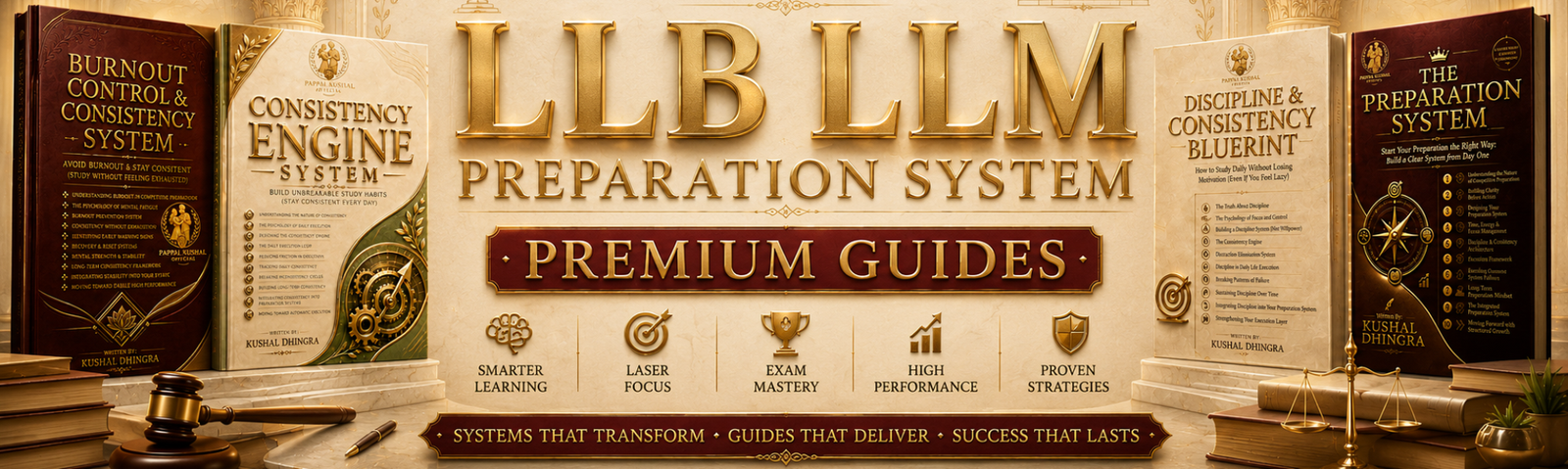
At this level, where understanding must translate into structured execution and professional competence, the platform introduces premium PDF Guides (E-books) designed specifically for individuals navigating demanding academic and professional pathways. These guides are developed to provide clarity in complex subjects, structure in preparation, and consistency in performance. They help you organize your study approach, manage time effectively, strengthen analytical thinking, and avoid common mistakes that often hinder progress. Rather than relying on scattered resources or unstructured methods, these guides offer a cohesive system that supports disciplined learning and practical application, making them particularly valuable for serious aspirants who seek efficiency and precision in their journey.
Beyond academic learning, it is essential to understand the broader professional landscape that follows legal education. The legal field offers diverse opportunities, each requiring a combination of knowledge, communication skills, and strategic thinking. To align your preparation with these opportunities, you are encouraged to explore /education-career/job-market-awareness/, where insights into career roles, industry demand, and evolving legal sectors help you position yourself effectively. At the same time, the ability to communicate arguments clearly, present ideas confidently, and engage with clients or stakeholders is equally important, which is why /education-career/personality-development/ supports the development of communication, confidence, and professional presence.
For individuals who aspire to extend their legal expertise beyond traditional roles, the platform also connects legal education with broader opportunities in policy-making, consultancy, and independent practice. Through /education-career/business-setup-guides/ and /education-career/msme-business-ideas/, you can explore how legal knowledge can be applied in advisory roles, compliance services, and entrepreneurial ventures, allowing you to operate with autonomy while leveraging your expertise.
The pursuit of LLB or LLM is therefore not a short-term academic choice—it is a long-term intellectual and professional commitment that demands discipline, curiosity, and a strong sense of responsibility. When approached with clarity and supported by structured systems, it can lead to highly respected and impactful careers across multiple domains. When pursued without direction, it can become fragmented and inefficient.
This section is designed to ensure that your journey remains structured, informed, and aligned with your aspirations. It provides not just information, but a refined framework for thinking, preparing, and executing at a level that reflects the true depth and significance of legal education.
Develop the ability to think critically, interpret with precision, and act with responsibility. Prepare with structure, progress with clarity, and when you are ready to move beyond uncertainty, step into the systems designed to support your growth in the field of law and legal intelligence.