


Operational Systems, National Connectivity, and the Discipline of Structured Execution
The railway sector represents one of the largest and most complex operational systems within the government framework, where infrastructure, logistics, engineering, and administration converge to sustain the movement of millions of people and vast quantities of goods every day. Careers within the railway system are not limited to routine employment; they are embedded within a network that drives economic activity, supports national connectivity, and ensures the continuous functioning of one of the most critical public services in the country. Within PappalKushal.com, this section is designed to position railway examinations not as basic entry-level opportunities, but as structured and system-oriented career pathways that demand clarity, consistency, and disciplined preparation.
At its core, the railway examination ecosystem is built around operational efficiency and technical precision. Unlike examinations that focus heavily on theoretical depth or descriptive analysis, railway recruitment exams emphasize practical competencies such as reasoning ability, quantitative aptitude, general awareness, and technical knowledge for specific roles. The objective is not only to test knowledge, but to evaluate the ability to function effectively within a structured system where accuracy, timing, and reliability are essential.
One of the defining features of railway examinations is the diversity of roles they offer, ranging from technical positions such as engineers and technicians to non-technical roles including clerical, administrative, and operational staff. Each category operates within a specific functional domain, and the examination pattern, syllabus, and selection process are designed accordingly. This diversity creates both opportunity and complexity, making it essential for aspirants to clearly identify their target role before beginning preparation. Understanding whether you are preparing for technical or non-technical positions directly influences your study approach, resource selection, and preparation strategy.
The journey within this section begins with clarity of direction, where aspirants are encouraged to understand the structure of railway recruitment boards (RRBs) and the various examinations conducted under their framework. This clarity ensures that preparation is aligned with the specific requirements of the chosen role, avoiding unnecessary overlap and improving efficiency. Whether the focus is on RRB NTPC, Group D, or technical posts, each pathway demands a structured approach that integrates subject knowledge with performance-oriented practice.
Once the direction is established, the focus shifts toward building a preparation system that emphasizes consistency and measurable progress. This begins with /education-career/government-exams/preparation-guides/how-to-start/, where aspirants are guided to establish a clear foundation by understanding the syllabus, exam pattern, and preparation timeline. This clarity is then translated into execution through /education-career/government-exams/preparation-guides/study-plan/, which helps in organizing preparation into disciplined phases, ensuring that each subject is covered systematically while maintaining regular practice and revision.
Resource selection plays a critical role in railway preparation, particularly given the wide availability of study materials. Through /education-career/government-exams/preparation-guides/booklist/, aspirants are guided to focus on essential and high-quality resources that provide conceptual clarity and sufficient practice, avoiding unnecessary overload. As railway examinations rely heavily on speed and accuracy, continuous revision and concept reinforcement become essential, which is why /education-career/government-exams/preparation-guides/note-making/ provides structured techniques to organize formulas, key concepts, and shortcuts in a way that supports quick recall during examinations. At the same time, maintaining consistency over long preparation periods requires mental discipline, making /education-career/government-exams/preparation-guides/burnout-management/ an important component in sustaining focus and avoiding fatigue.
As preparation advances, the emphasis must shift toward performance optimization, where mock tests, time management strategies, and accuracy analysis become central to improving results. Railway examinations demand repeated practice under timed conditions, where even small improvements in speed and precision can significantly impact overall performance. This stage requires a disciplined approach, where aspirants continuously evaluate their performance, identify weaknesses, and refine their strategies accordingly.
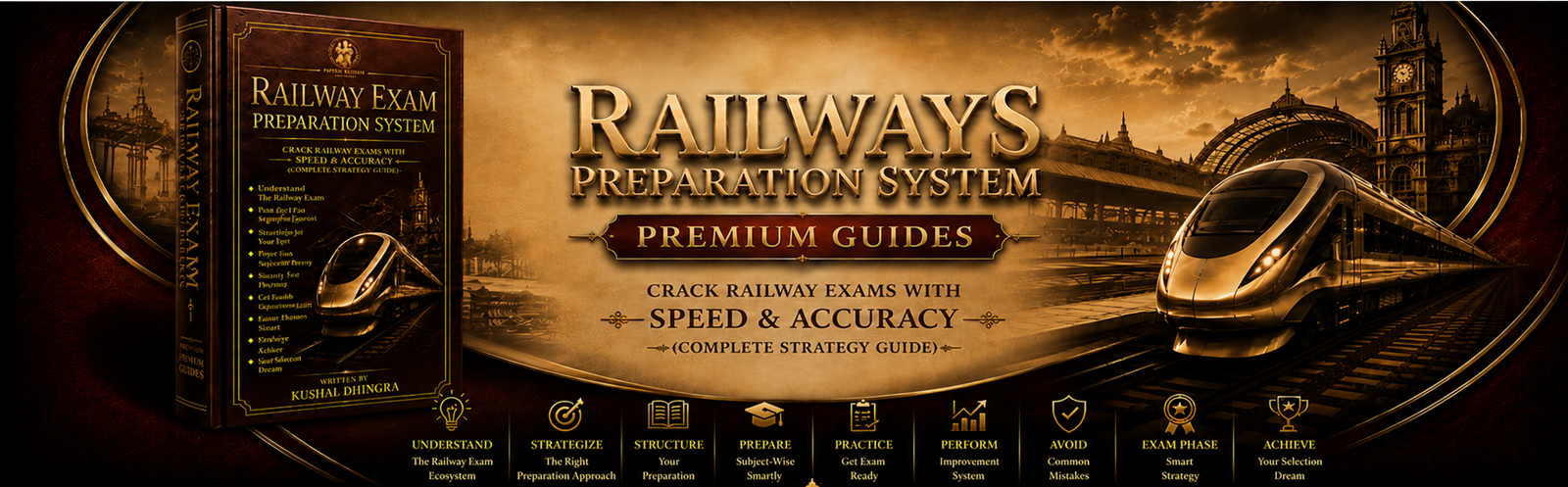
At this critical stage, where preparation must evolve into measurable performance, the platform introduces premium PDF Guides (E-books) designed specifically for aspirants preparing for system-driven examinations like railways. These guides provide structured frameworks for managing preparation, improving speed and accuracy, organizing revision cycles, and maintaining consistency across practice sessions. They are designed to eliminate inefficiencies, reduce confusion, and provide a clear pathway from preparation to performance. For aspirants who understand the importance of disciplined systems in achieving success, these guides serve as a valuable tool in converting effort into results.
Beyond the examination, it is equally important to understand the professional opportunities and career progression associated with railway roles. These positions offer stability, structured growth, and the opportunity to work within one of the most extensive public service networks in the country. To align preparation with these opportunities, aspirants are encouraged to explore /education-career/job-market-awareness/, where insights into roles, salary structures, and career progression provide a realistic understanding of life within the railway sector. At the same time, developing communication, confidence, and professional skills through /education-career/personality-development/ ensures that aspirants are prepared not only to clear the examination, but also to perform effectively in their roles.
For those who wish to maintain flexibility in their career journey, the platform also connects railway preparation with broader growth pathways through /education-career/msme-business-ideas/ and /education-career/business-setup-guides/, ensuring that the skills developed during preparation remain valuable across multiple domains.
The journey toward railway careers is therefore not defined by simplicity—it is defined by structured preparation, consistent performance, and the ability to operate within organized systems. It requires a clear understanding of the examination process, a disciplined approach to study, and the ability to refine performance through continuous practice and evaluation.
This section is designed to ensure that your preparation remains structured, efficient, and aligned with your goals. It provides not just information, but a refined framework for thinking, preparing, and executing at a level that reflects the true nature of railway examinations and operational systems.
Build consistency, master precision, and align your preparation with structured systems. Begin with clarity, refine your execution with discipline, and when you are ready to move beyond uncertainty, step into the frameworks designed to support your success in railway careers.